
Safe Spaces

posted in: Personal | 0

“Do they exist or are they spooks?”

Classics professor Coleman Silk’s question is playful, casual. Its ramifications are serious, dire. He is accused of using a racial epithet about two repeat absentees he does not know are African American. Is it possible to make a racist slur when you don’t know a person’s race? Coleman’s persecutors are not interested in the niceties of such questions. Professor Silk loses his job.

This lexical faux pas, the precipitating event in Philip Roth’s novel The Human Stain, was brought to mind this week when I made my own verbal misstep and found myself at the receiving end of student umbrage.

“So you sat down because you were lazy?” (“Tired” was surely the better word for both denotation and connotation.)

It was the very end of the day. We had nothing left to do but pack up. Yet I called the class together to go over the page they had just been working on with a partner. The teacher had not asked me to do this in the lesson plan, but I was determined to elevate a less-than-solid work period by providing a degree of closure. I may have been driven, too, by a masochistic impulse to sabotage an otherwise successful day with a difficult group of students.

Question number 5 had asked them to consider the fairness of charging a higher price for oranges after a hurricane in Florida. Engagement was weak, so I asked the yeahs to stand up and the nays to remain seated. As I might have predicted, most followed the early standers by slowly rising themselves. Only three stayed in their seats. I asked for their reasons but each demurred. The first hadn’t hear the question. The second, on second thought, changed his mind. The third insisted that, oh yeah, he had been standing, yet oddly (to me) he didn’t then correct the record by getting (back) up on his feet.

Thence my ill-phrased question.

If his eyes didn’t immediately narrow into a glower, they soon did. He was clearly upset, in an indignant sort of way. I compounded the indignity.

“You don’t have to be offended,” I might have said, or intended to say. More likely, I said something like, “That wasn’t mean,” or, “It wasn’t an insult.” But, like a joke, if you have to explain yourself, it doesn’t really work.  To my shame, in fact, “It was just a joke” or, “I was only teasing,” nearly leaped from tongue. Fortunately, I was able to stuff it back before demeaning myself with a lame schoolyard rejoinder. It was true that I had been using humor, as I often do, to break the tension, or perhaps engage the attention. In this instance it was maladroitly done.

I continued to misread the situation. M’s glowering and then his words put me on the spot, challenged me even. Before I knew it, I was engaging with him in full view of the class, putting on a show of the very worst kind. The situation was so fraught, my memory of it is blank. I remember just one remark. He asked rhetorically, “What’s wrong with this [picture]?” as in, a teacher isn’t supposed to insult a student. The class’s silence assented loudly. P, when I asked her, avowed it directly.

I understood then I was on the wrong side of history, as it were, so, after dismissing the class to pack up, I quietly made my apology to M. (He accepted it gracefully, but it would have been nice for him to have apologized to me. Nice for me;  important for his growth for him.)  A few minutes later, before dismissing the class for the day, I apologized to all, working hard to swallow the taste of crow.

The confrontation and my comeuppance left me shaken, and because of who I am, I could not easily shrug it off. I felt threatened, attacked, like a cornered animal. Even as I snarled and hissed in my thoughts, I recognized the imbalance. I am a grown man, more than grown, well on the backside of the hill. M is a child, still developing, insecure by definition. Why am I viewing him as a threat? Why am I flirting with playing the bully? I basically know the answers to these questions, but they are not the subject of this post, which is closer to Roth’s subject in The Human Stain.

It may be grandiose to compare my teacher-student dust-up with Coleman Silk’s life-changing (if fictional) ordeal. Perhaps. But I write to learn, write to better understand.

Today we call it cancel culture. Silk is canceled for his racial insensitivity, even though, we learn, he is actually a light-skinned African American who has been passing as white (Jewish) all his professional life. (The irony is rich.) I have already been “cancelled” once for allegedly striking a child. (A very defiant one.) Well, three witnesses to the interaction, his peers, wouldn’t go that far. I merely grabbed him firmly by the arm, they said. The principal and his assistant both addressed these accusations with me without allowing me to face my accusers. I was canceled (terminated) from an entire school district based on the testimony of minors: an aggrieved student and three peers who were no doubt afraid to cross him. [NB: I might have kept my job if I had challenged their allegations more forcefully while, at the same time, accepting their overall narrative. I could not deign to do either.] That history accounts for my overreaction to the boy’s accusatory glower and the tacit support given him by his peers. Was I looking at another cancellation?

But why the glower in the first place? I suppose, if another student would have shrugged it off and another would have cried into folded arms on her desk, this boy had his own way of responding. He perceived a threat: humiliation. Would it be fight or flight? He chose to fight.

But what about the words, “What’s wrong with this [picture]?” There was a time, after all, when pupils could expect to be berated by teachers, or at least to see their friends scolded, humiliated, punished. That was the “picture” they saw and expected. In the twenty-first century, a teacher who does not fit the nurturing, progressive model can be called out…by a kid.

True, my sardonic query had more than a hint of the passive aggressive to it. It is also true that there was nothing personal about it. I ore no grudge against the boy; he had, as yet, made no impression on me. Still, as the third in a sequence of students ducking the question at hand, he bore the brunt of my frustration, frustration that had built up over an entire day with a difficult class. I was wound tight as a thread on a spool, and the façade of control finally cracked.

M really did believe I was insulting him. I know enough about child development to excuse his misapprehension of my attempted irony and to condemn myself for same. On the other hand, his immediate, uncompromising response left me no room to make the humor intelligible. His dukes went up, his fur bristled. My own defensiveness followed soon enough. If either one of us were not so brittle, so hair-triggered, the whole contretemps might have (would have) been avoided.

M’s humiliation was no less real for being rooted in a misunderstanding. I was not saying he was lazy, as he believed (or said he did), but I was saying he hadn’t done his job. I was, also, without meaning to, accusing him of not being honest. I might have let these things pass. I might have said them more directly. Instead, I expressed them obliquely, with so-called humor that stung. I had made the unforgiveable sin of the teacher: to embarrass–or, worse, humiliate–the student in front of the class.

In writing this post, I wanted to be able to paint M as a poster child for child-centeredness run amok, for the unintended consequences of excessive child empowerment. But I can’t. M’s prickliness is all his own, part genetic, part environmental, just as my own is. That he could stand up to a teacher as he did indicates he is prickly in a way that I wasn’t at that age. He may, in fact, be an outlier.

Besides, the event took place at the very end of the day. M (and the rest of his classmates) were starting to check out, as they had every right to do. I suspect he never really processed my question. He wasn’t really not doing his job. He was just being a kid who allowed his attention to shift away from the teacher’s agenda in the final three minutes of the day. He had no way of knowing that his strategy for responding to being caught out was the exact wrong one for this particular substitute. Likewise, his substitute fumbled his own response. Disaster was averted by a simple apology, actually two. A third might have made a big difference in how this substitute came away from the altercation.
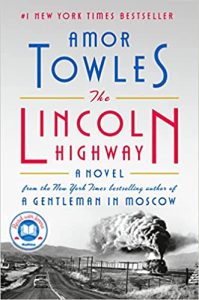
“Lincoln Highway” Heads in a Different Direction

posted in: Good Reads: Fiction | 0

I probably would have read anything that came out by Amor Towles. That his third book was titled The Lincoln Highway made it inescapable. I, who had read about Carl Fisher and the Lincoln Highway, Cy Avery and Route 66, the transcontinental firsts of Horatio Jackson and Alice Ramsay, knew I must read this apparent paean to the American road. That the  story was set in 1954 and not 1924 discomfited me but little. A road trip west on the historic first transcontinental highway which took twenty-two years to see its way to paved completion: I was all in. Except Towles’s latest book didn’t turn out to be that at all. The characters don’t even drive on the Lincoln Highway, at least not in a westerly direction or for very long. Most of the book takes place in New York City. And the protagonists get there by rail–hopping a freight car–not road.

Is this is Amor Towles’s idea of a literary joke? His title is complete deception, like a magician’s misdirection, except the I didn’t sit down for a magic trick. The flapping white dove he pulled from his cape was impressive and all, but it is not exactly what I signed on for. I felt a little bit had–pleased and had, but had all the same.

I’m creating my own misdirection: I loved the deception. I loved feeling had. I was a little bit in awe of his audacity, a little breathless at the novelty.

The Lincoln Highway

The skill with which Towles limns his characters is no joke. And of all the colorful characters ins this book, none is as original or as endearing as eight-year-old Billy. Unusually gifted, Billy has read Abacus Abernathy’s Compendium of Heroes, Adventurers, and Other Intrepid Travelers twenty-four times as the novel begins (twenty-five by the time it ends). The book tells the condensed stories of mythical and historical heroes in twenty-six chapters from Achilles to Zorro, leaving eight blank pages for reader to record the story of his own adventures. Taking his cue from Homer and others, Billy determines to start is story in medias res. Where is that middle of the story? After consideration, he places it (unsurprisingly) exactly where Towles started his, in the first chapter of the novel, which he labels “Ten.” For my part, I couldn’t help thinking it would come at the novel’s end, just as Billy, Emmett, and Sally are about to start out from Times Square on the Lincoln Highway: to seek their fortune–and possibly their mother–in California. Again, Towles makes his reader wonder.

There is another deception he commits in the person of one of his characters, a deception that is more discomfiting than a mere misleading title. Towles tells his story from multiple points of view: Billy, Emmett, Duchess, Woollie and several secondary characters, as well. Only Duchess gets the first person, and, as such, his voice comes through loud and clear. It is an appealing voice, street-toughened but as loyal a friend as you are likely to meet. From Sister Agnes in the orphanage, he has learned a kind of Newtonian law of justice, an accounting which requires that offences be paid back at par. By his accounting, the insouciant instigator of Emmett’s beating deserves a payback. So Duchess whacks him upside the head with a two-by-four. Warden Ackerly owes big for his mistreatment of the juvenile inmates at Salina. So, Duchess hits the sleeping ex-warden over the head with a frying pan. Duchess is nothing if not scrupulous in his accounting. He travels uptown to Harlem so he can give three uncontested slugs to his chin as payment for his own transgression in Salina.

All this head-bonking and fist-throwing had me reeling, I’ll admit. The image of a young man collapsing under the blow of a piece of lumber–no matter how heinous he had behaved in the previous scene–was hard to take. Ditto the dropped-anvil beaning of a sleeping man, no matter the crimes perpetrated off-stage, as it were, before the action of the book even began. Duchess was clearly a sympathetic character. I wanted to support his actions, but I couldn’t. I agreed with the premise of Sister Agnes’s philosophy but couldn’t carry it to the conclusion Duchess does. Misdeeds may require a reckoning, but we humans can’t know precisely what that reckoning is. The legal system is cumbersome enough. How much more dangerous when individuals appoint themselves judge and jury, too.

I couldn’t figure out what Towles was doing. Was he being manipulative, making us supportive of morally questionable acts because they were carried out by a sympathetic character? Was he being deceptive, giving a false impression to be overturned by later events? It was the latter, but it took the entire book to play out.

In the novel’s final chapters, we see Duchess in an altogether different light. We might have paid more attention to the warning signs. We learn early on he was abandoned by his father for a pretty blonde. We hear Sister Agnes tell Emmett that Duchess needs a friend, needs his friendship. Later T. cautions Emmett from getting too involved with Duchess. He brings trouble in his wake. We learn that his father’s perfidy was worse–much worse–than we could have imagined. Towles gave us more than enough warning that Duchess was damaged goods. Yet still I wanted to believe. I wanted to believe in his ultimate goodness.

Fifty Dollar Bills

This is Towles’s way of showing that “nice is different than good.” Childhood trauma can stick its claws into a person and never let go. For, as much as Duchess has distanced himself from his father, yet he can’t escape his own fatal cupidity. At least, he doesn’t escape it. In the penultimate scene, he beans Emmett with a stone in an effort to secure Woollie’s inheritance. After Emmett comes to, he threatens him and Billy with a rifle. He betrays his friends as his father betrayed him. In the final scene, Duchess chooses fifty-dollar bills over life. He literally sinks his lifeboat to secure the loot, knowing full well he doesn’t know how to swim. It would be comic, if it weren’t so terribly sad.

Thus does Duchess, in the first person, tell of his own demise. Thus does the book’s most comic character leave the reader with a deep sadness, as he turns the final page. Sadness and discombobulation. Why? Why did Towles do this to us? Call the book The Lincoln Highway and assiduously keep his characters from driving on it? Create a comic character whose past dooms him to a very dark ending? Strangely, there is pleasure in the unsettling. Towles knows this, and he pulls it off skillfully.

Speaking of Reflection and Choice

Alexander Hamilton asked if people are truly capable of governing themselves by reflection and choice or if they are, instead, doomed to be buffeted by the whims of accident and force. Jill Lepore made it the organizing question of her 800-page history of the United States, These Truths. David Graeber and David Wengrow argue emphatically for choice in their 500-page history of humanity, The Dawn of Everything. They argue against not accident and force but the immutable laws of history, the stages of human development, that limit our thinking. Further, they argue that humans exhibit choice in more than constitutional government. They find evidence in the archaeological record for choice in social relations and economic systems, as well. We are freer than we think. Graeber and Wengrow’s lens is wide angle to Lepore’s (relative) zoom. The scope of each work is so radically different that it may be wrong to say they are concerned with the same question.

Graeber and Wengrow never mention Civilization and Its Discontents, but they might as well have. I remember encountering Freud’s slim book in  college and finding it revelatory. If Freud was too-consumed by sex, so was I: twenty-years-old, horny as hell, and no clear way of satisfying my urges. But the broader themes resonated, too. Civilization comes with a cost. We repress more than sexual urges in the name of an orderly society. This quickly became a truism for me–and I am not alone. Even among the most well-informed in the academy, Graeber and Wengrow insist, the notion persists that societal complexity requires the giving up of freedoms. The agricultural revolution led to the rise of private property, private property promoted social hierarchies, social hierarchies required laws and enforcement to preserve those hierarchies. It is a devil’s bargain we entered into ineluctably and one we are stuck with. At least, that is the assumption that undergirds almost every work in the authors’ fields, anthropology and archaeology. Their book is an attempt to blast this assumption out of the water.

J-J Rousseau

The book starts, inevitably, with Rousseau and Hobbes. Their opposing concepts of the State of Nature not only instigated one of the most significant debates of the Enlightenment, they continue to affect our thinking to this day–with pernicious results, in Graeber and Wengrow’s view. Yet the authors do more than critique. In a detailed historical analysis, they show how Native Americans influenced the Enlightenment discussion from the first, not only on the state of nature, but in the nature of good government, freedom, and equality. They call it the indigenous critique of the European (Western) civilization. The bulk of their evidence comes from a seventeenth century anthology, Jesuit Relations of New France, from which they cite several block quotations, including this one from Father Jerome Lallement:

From the beginning of the world to the coming of the French, the Savages have never known what it was so solemnly to forbid anything to their people, under any penalty, however slight. They are free people, each of whom considers himself as much consequence as the others; and they submit to their chiefs only in  so far as it pleases them. [44]
Jesuits in New France

The American “savages” provided more than an example of state-of-nature freedom. They provided models of “reasoned debate,” from which they found “a form of pleasurable activity in [its] own right.” This allows the authors to make a yet more provocative claim:

…it appears to have been exactly this form of debate–rational, sceptical, empirical, conversational in tone–which before long came to be identified with the European Enlightenment as well. And, just like the Jesuits, Enlightenment thinkers and democratic revolutionaries saw it as intrinsically connected with rejection of arbitrary authority…. [46]

This is heady stuff. Maybe “Eurocentrism” really has distorted our view of history in a major way even if, near the end of the book, the authors qualify their earlier implications:

No doubt it would be too much to suggest that the Enlightenment itself had its first stirrings in seventeenth-century North America. But it’s possible, perhaps, to imagine some future, non-Eurocentric history where such a suggestion would not be treated as almost by definition outrageous and absurd. [473]
Cahokia

American civilizations at Cahokia and Natchez, Tenochtitlan and Cuzco, the Pacific Northwest and northern California feature in the book, as do others in America, Mesopotamia, Nilotic Africa, Eastern Europe, South Asia, and China. The explication is detailed and complex: a cumulative rebuttal of a simplified stages-of-development view of human history. Instead, they show how “human beings have spent most of the last 40,000 years or so moving back and forth between different forms of social organization, building up hierarchies then dismantling them again.” [112] One of the main mechanisms they identify for all this flexibility is play.

Technologies, those supposed drivers of human history, were often developed for as art or ritual before they were put to practical or economic use. The authors point to examples of ceramics, mining, steam power, and gunpowder as evidence. “The zone of ritual play,” they say, has been a “scientific laboratory” and a “repertory of knowledge”–and not just for technology but “as a site of social experimentation.” [500-501] Graeber and Wengrow mention many examples of play kings, or playing at kingship. The trappings were present, but real power was absent. These play kings or chiefs or big men may have been primus inter pares, they may have garnered ritualized respect, but no one felt obliged to do what they said. This unintuitive fact allows Graeber and Wengrow to muse: “the real puzzle is not when chiefs or even kings and queens, first appeared, but rather when it was no longer possible simply to laugh them out of court. [133] (We have play monarchs again today. See Queen Elizabeth II.)

There is precedent for choice and experimentation. Our ancestors were more free than we have thought–the authors identify three essential elements to freedom: to move or relocate, to ignore or disobey commands, to shape new social realities–so we, today, may not be as stuck as we think. Graeber and Wengrow caution us to resist reductive thinking, to reject the truism that greater population and social complexity necessitates greater hierarchy and social control. They saw no such cause-and-effect evident in the archaeological and anthropological record. On the contrary they found that our distant ancestors “moved regularly back and forth” between different social and economic systems, even as “nowadays most of us find it increasingly difficult even to picture what an alternative…order would be like.”  [502]

Cambrian Explosion

Graeber and Wengrow are convincing. They are thorough in their mastery of the record, and they are scrupulous about qualifying assertions that bleed toward speculation or that are partially contradicted by the record. But have they really debunked the “stubborn misconception” that scaling up requires sacrificing freedom? In the distant past, villages scaled up to towns scaled up to cities. Today’s scales may, in fact, be qualitatively different when the entire habitable surface of the earth is populated, when we appear to be close to filling the petri dish. The authors acknowledge the non-reproducibility of history, but are they ignoring it in this case? Does the distant past  represent a kind of Cambrian Explosion, a proliferation of social forms followed by a winnowing to a narrower range? We don’t have to be talking about hard and fast laws of history to recognize that historical change can entail the types and frequency of change itself.

That said, it is clear to me that Graeber and Wengrow are onto something big. First, our understanding of the past has likely been seriously wrong. That misunderstanding has surely distorted our understanding of the present and limited our ability to imagine better futures. But choice is available, they argue, as long as we can overcome our false notions and our atrophied imaginations. If not, we will remain slaves to accidents of history and the force of increasingly depersonalized bureaucracies and increasingly unaccountable and powerful individuals.


Force or Choice?

posted in: Good Reads: Nonfiction | 0

In These Truths, Jill Lepore asks her reader to consider a central question as she makes her way through her 800-page survey of American history. It is a question first posed by Alexander Hamilton in 1787 in what became known as Federalist Paper #1. He asked newly independent Americans faced with a constitution to ratify, or not, “whether societies of men are really capable or not of establishing good government from reflection and choice, or whether they are forever destined to for their political constitutions on accident and force.” Lepore asks us, possibly cynical, likely concerned, twenty-first century Americans to contemplate the same question. The earnestness with which she addresses us makes clear this is no rhetorical question.

We know the delegates of the Constitutional Convention and the state legislatures who ratified their work did choose the government that, in amended form, still guides us today. Yet in reading Lepore we better understand the extent “accident and force” have played throughout our history, including and perhaps especially in our current time of political polarization, disputed elections, and doubts for democracy. If we feel buffeted, we are. If we feel hopeless, helpless, we are not. Reflection can make real choice possible.

Political Factions

Lepore has structured America’s story in four parts: The Idea (1492-1799), The People (1800-1865), The State (1866-1945), The Machine (1946-2016). Each part, in turn, is subdivided into four chapters. Each chapter begins  with an introductory section which sets its theme suggested by its title. While some of these sections feel like ordinary introductions, more than a few are uncommonly inspired, none more so than chapter 7, “Of Ships and Shipwrecks.” Lepore opens with the scene of Secretary of State Abel Upshur’s untimely demise aboard the corvette USS Princeton. The last of a series of ceremonial deck gun salutes misfired, exploded, and killed seven, including Upshur and the Secretary of the Navy. “The death of Upshur had serious political consequences,” writes Lepore. [236] President Tyler replaced him with Southern firebrand, John C. Calhoun. Where Ushur had promoted the annexation of Texas as an issue of liberty, keeping the issue of slavery mostly unstated, Calhoun “talked about Texas only with reference to slavery.” (The ship theme returns throughout the chapter, from a poem by Longfellow to the death at sea of Margaret Fuller.)

Britannica

Indeed, the United States’ continuing expansion in these years “led to…staggering constitutional distortions and moral contortions.” [262] Even if adopted by choice, Lepore implies, its ratification requires continual renewal by each subsequent generation. Accidental gray areas, not explicitly accounted for in the Constitution, become political battlegrounds. Partisans resort to force–raw power–to better shape it to their purposes. Texas and California, Kansas and Nebraska: states were traded, slave and free, to ensure the balance of power. But the balance wouldn’t hold. Violence and force erupted: Bleeding Kansas. As  soon as its losing position became irreversible, the Southern states seceded. Civil War ensued.

Senate.gov

But other incidents of accident and force threatened the adolescent Republic. A national bank was not chartered in the Constitution. Some were for it; some were agin’ it. President Andrew Jackson was very much in the latter camp. He abolished the Second Bank of the United States and threw the country into the worst economic panic to date. Future leaders would interpret the constitutional issue differently. In these mid-nineteenth century years, Congressmen were driven to use canes and fisticuffs to press their political positions: “Although hardly ever reported in the press, the years  between 1830 and 1860 saw more than one hundred incidents of violence by congressmen, from melees in the aisles to mass brawls on the floor….” [244] Bowie knives and pistols were common accessories for Southern Congressmen.

iStock

With the country and its leaders in such a state of rancor, it wasn’t uncommon to fall prey to pessimism. Lepore  highlights Henry Wadsworth Longfellow’s despondency in his poem, “The Building of the Ship” (1849).

…where, oh where,
Shall end this form so rare?
…Wrecked upon some treacherous rock,
Rotting in some loathsome dock,
Such the end must be at length
Of all this loveliness and strength! [259]

But the contingencies of history are such that, in the end, Longfellow left us a more hopeful poem. A dinner guest later that year, Charles Sumner waxed enthusiastic about the new Free Soil Party he was joining and,  hence, almost optimistic about the Republic. Longfellow was inspired to try a new ending for his poem:

Sail on! Sail on! O Ship of State!
For thee the famished nations wait!
The world seems hanging on thy fate! [260]
Karlee A Turner
Karlee A Turner

Lepore returns to Longfellow’s metaphor in her final chapter, “The Question Addressed.” “Can a people govern themselves by reflection and choice? Hamilton had wanted to know, or are they fated to be ruled, forever, by accident and force, lashed by the violence of each wave of surging sea?” Looking at recent years, this is what she discerned:

The ship of state lurched and reeled. Liberals, blown down by the slightest breeze, had neglected to trim the ship’s sails, leaving the canvas to flap and tear in a rising wind, the rigging flailing. Huddled below decks, they failed  to plot a course, having lost sight of the horizon and their grasp on any compass. On deck, conservatives had pulled up the ship’s planking to make bonfires of rage: they had courted the popular will by demolishing the idea of truth itself, smashing the ship’s very mast. [788]

After eight hundred pages of text and four hundred years of history, it becomes clear that Hamilton’s question has no definitive answer. Rather, it is a perennial question to be answered continually by each subsequent generation. In those times when accident and force are most salient, the importance of reflection and choice becomes all the more heightened. We are in one of those times now, a time when it is well to consider Lepore’s final admonition: “A nation cannot choose its past; it can only choose its future.”